
Thoughts from reading Robert Jay Lifton’s book, The Protean Self: Human Resilience in an Age of Fragmentation. Post 1
Thoughts on LIfton's book

I am reading Robert Jay Lifton’s book, The Protean Self: Human Resilience in an Age of Fragmentation. It was written 32 years ago, in 1993, and I believe it is even more relevant now than when it was written.
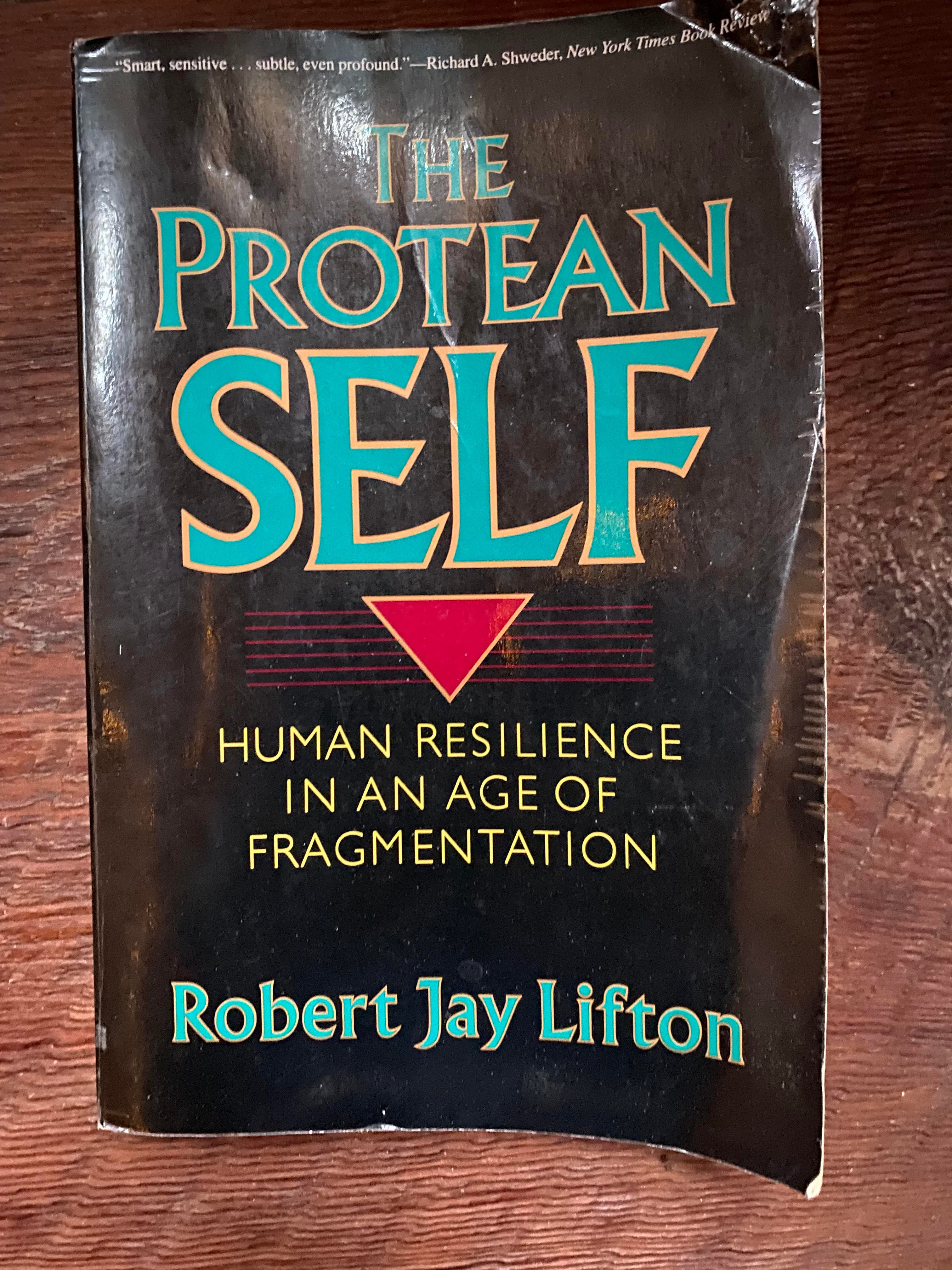
In the Preface Lifton writes, “Proteanism seemed to strike a nerve in people, as the essay has been reprinted in more collections than has anything else of mine. Readers have frequently told me that its focus on a many-sided self in constant motion reflects their own experience… My own view is that the protean self can help people renew their relationships to cultures, Western and non-Western, that are now under duress.”
Chapter 1: We are taught that constancy and stability are the values to strive for and these kept me in my cult way too long. We took a “Vow of Stability”, promising to never leave. This goes against our human nature to evolve and adapt to changing circumstances, and it does not take into account that human nature is not perfect, and our leaders can go astray, become corrupt, and start to harm us. We need to be free to assess and change course over our lifetimes. Instead of seeing ourselves as unsteady, neurotic, or worse, as our cult leaders liked to portray us (and therefore needing only their help to “save” us), we can come to see ourselves as discerning and capable of charting our own course.
After I left, I did feel like I was just bungling along, but over the years I have discovered that I have a core self who is wise, capable, and strong.
Lifton outlines the major changes that have affected not only the national and international landscapes, but our individual lives also, our attitudes and views of our personal worlds. Our personal self-identity is influenced by larger history. Here in America our context has included colonization and revolution, migration to the western frontier, the civil war, massive immigration, major wars outside of the U.S., and a lot of social change. Rapid historical/national change, the mass media revolution and the threat of human nuclear extinction have all influenced us in ways we are not always aware of. Positive change happens; the ending of the Cold War and nuclear disarmament programs, the break-up of the old Soviet Union, radical political progress in America. Negative backlash also happens, genocidal policies abroad, negative political reactions, and ongoing problems with unemployment, drugs, race, and crime, as well as breakdowns in education and healthcare.
How do we navigate all these influences? Life in the cult was so intense, I naively thought anything would be better once I left. Therefore, I went through a wake-up period where I became aware of all the problems in society at large. At first, I was a bit shocked, and was very disappointed. I never went back to thinking the cult had it right, or was better than the world at large, but it did take some getting used to the struggles all around me. It requires a balancing act between caring about broader struggles, and the needs of my daily life and mental well-being.
I love this quote from Vaclav Havel, the past president of the Czech Republic. “How does it all fit together? Why don’t these paradoxical qualities cancel each other out instead of coexisting and cooperating with each other?...How can I – this odd mix of the most curious opposites – get through life, and by all reports successfully?”
I love how this validates and normalizes the disparate parts of myself that coexist and even cooperate. In the cult you weren’t “OK” unless you fit the mold, obeyed all the rules, and had the corporate attitude. Learning to have the freedom to be not just one thing, but a blend and mixture of various states, attitudes, thoughts and emotions is a heady and wonderful journey.